

在線工具
java https://c.runoob.com/compile/10
在線編寫運行 Java 8 https://www.tutorialspoint.co...
SQL 在線運行 https://www.bejson.com/runcod...
Java牛客題庫 https://www.nowcoder.com/inte...
JDK, JRE, JVM
- JDK : Java Development Kit
- JRE : Java Runtime Enviroment
- JVM : Java Virtual Machine
輸出Hello Wolrd
vim Hello.java
public class Hello{
    public static void main(String[] args){
        System.out.print("Hello World!");
    }
}
編譯
javac Hello.java
執行
java Hello
輸出
Hello World!Java程序運行機制
- 編譯型:
- 解釋型:
-
程序運行機制:
源文件(*.java) => Java編譯器 => 字節碼(.class)
=> JVM ( 類裝載器 =>字節碼校驗器 => 解釋器 )
=> 操作系統平台
IDEA
新建工程
File => New => Project… => Empty Project
File => Project Structure => Project => Project SDK (1.8.0) => Project language level (8) => OK
基礎語法
1.註釋,標識符,關鍵字
註釋
//單行註釋
/* 多行註釋 */
/**
  * 文檔註釋
  * @Author itxiaoma
  */
標識符
類名,變量名,方法名都稱為標識符
- 標識符以字母,美元($),下劃線(_)開始
- 首字母后可以是字母,美元($),下劃線(_),數字的組合
- 不能使用關鍵字作為變量名,方法名
- 大小寫敏感
關鍵字(50+)
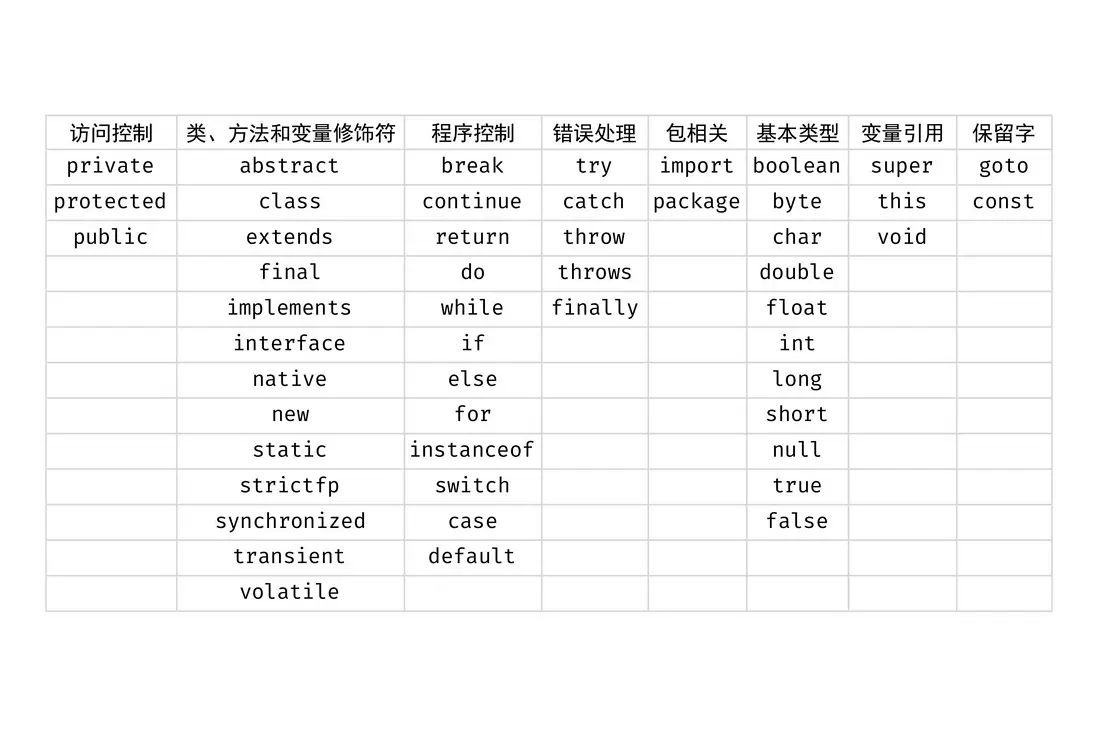
2.數據類型
強類型語言:變量使用必須嚴格符合規定,所有變量都必須先定義後才能使用
Java數據類型
-
基本類型:(8大基本類型)
-
數值
-
整數
- byte:1個字節(-128~127)
- short:2個字節(-32768~32767)
- int:4個字節(-2147483648~2147483647)21億+
- long:8個字節(例:long num=40L;)
-
浮點
- float:4個字節(例:float num=40F;)
- double:8個字節
- 字符串char:2個字節
-
- boolean:1位,true/false
-
- 引用類型:類,接口,數組
注1:String不是數據類型,是類
注2:1bit表示1位;(bit是計算機內部數據存儲的最小單位)
1Byte表示1個字節,1B=8b;
1KB = 1024B;
1MB = 1024KB;
1GB = 1024MB;
1TB = 1024GB;
Java數據類型的常見問題
-
整數擴展
int a = 10; int b = 010;//八進制 int c = 0x10;//十六進制 -
浮點型擴展
float f = 0.1f; double d = 1.0/10; System.out.println(f==d);//false float d1 = 123123123123f; float d2 = d1 + 1; System.out.println(d1==d2);//true //float 有限 離散 舍入誤差 接近但不等於 //不要用浮點數進行比較 //數學工具類BigDecimal -
字符類擴展
char a = 'a';
System.out.println((int)a);//97
char a1 = '\u0061';
System.out.println(a1);//a
//所有的字符本質還是數字

轉義字符:
\t 製表符
\n 換行
...
3.類型轉換
運算中,不同類型的數據會先轉換位同一類型,再進行計算
優先級:低 ==> 高
byte,short,char => int => long => float => double
自動轉化:低 => 高
強制轉換: 高 => 低 (類型)變量名
注1:
- 不能對布爾值進行轉換
- 不能把對象類型轉為不相干的類型
- 高容量轉低容量,會有內存溢出或精度問題
注2:JDK7的新特性,數字間可以用下劃線分割(1000 = 1_000)
4.變量、常量、作用域
變量
int a = 1;常量 - final
常量:初始化後不能改變,一般為大寫
static final double PI = 3.14;作用域
- 類變量
- 實例變量
- 局部變量
public class Hello {
    //類變量:static
    static int a = 1;
    //實例變量:屬於對象,不需要初始化(會自動初始化為類型默認值)
    //布爾值默認false,除基本類型以外其他變量都是null
    String b;
    public static void main(String[] args) {
        System.out.println(a);

        int c = 3;//局部變量:必須聲明和初始化
        System.out.println(c);

        Hello obj = new Hello();
        System.out.println(obj.b);//null
    }
}
命名規則:
- 類變量,局部變量,方法名:駝峯(首字母小寫)
- 常量:大寫 + 下劃線
- 類型:駝峯(首字母大寫)
5.基本運算符
- 算術運算符:+, -, *, /, %, ++, --
- 賦值運算符:=
- 關係運算符:>, <, >=, <=, ==, !=, instanceof
- 邏輯運算符:&&,||,!
- 位運算符:&, |, ^, ~, >>, << , >>>
- 條件運算符:? :
- 擴展賦值運算符:+=, -=, *= ,/=
例:
long a = 123L;
int b = 123;
short c = 10;
byte d = 8;
System.out.println(a+d);//long
System.out.println(b+c);//int
System.out.println(c+d);//int
//結論:有long類型時轉long,否則轉int
冪運算:2^3
double pow = Math.pow(2, 3);
System.out.println(pow);//8.0
位運算
<< 乘2
>> 除2
6.包機制
包的本質就是文件夾
- 包機制是為了更好地組織類,用於區別類名的命名空間
- 一般用公司名倒置作為報名 pakage com.baidu.www;
- 使用import導入包(import 包名.* 表示導入包下所有類)
7.JavaDoc生成文檔
註釋參數
/**
 * @author 作者
 * @version 版本
 * @since 需要最早使用的jdk版本
 * @param 參數
 * @return 返回值
 * @throws 異常拋出
 */
中文編碼
javadoc -encoding UTF-8 -charset UTF-8 Demo.java流程控制
1.用户交互Scanner (Java5新特性)
基礎使用
import java.util.Scanner;

public class Demo {
    public static void main(String[] args) {
        //創建掃描器對象,用於接收鍵盤數據
        Scanner s = new Scanner(System.in);
        //判斷用户輸入
        if(s.hasNextLine()){
            String str = s.nextLine();
            System.out.println(str);
        }
        //IO流的類會一直佔用內存,用完需要關閉
        s.close();
    }
}
//next()以空格為結束符,nextLine()以回車為結束符
使用進階
計算多個數字的總和與平均數,非數字結束
Scanner s = new Scanner(System.in);
double sum = 0;
int num = 0;
while(s.hasNextDouble()){
    double x = s.nextDouble();
    sum += x;
    num++;
}
System.out.println("和是:" + sum);
System.out.println("平均值是" + (sum/num));
s.close();
2.九九乘法表
/*
1*1=1
2*1=2    2*2=4
3*1=3    3*2=6    3*3=9
4*1=4    4*2=8    4*3=12    4*4=16
5*1=5    5*2=10    5*3=15    5*4=20    5*5=25
6*1=6    6*2=12    6*3=18    6*4=24    6*5=30    6*6=36
7*1=7    7*2=14    7*3=21    7*4=28    7*5=35    7*6=42    7*7=49
8*1=8    8*2=16    8*3=24    8*4=32    8*5=40    8*6=48    8*7=56    8*8=64
9*1=9    9*2=18    9*3=27    9*4=36    9*5=45    9*6=54    9*7=63    9*8=72    9*9=81
*/
for (int m = 1; m <= 9; m++) {
    for (int n = 1; n <= m; n++) {
        System.out.print(m + "*" + n + "=" + (m * n) + "\t");
    }
    System.out.println();
}
//System.out.print 不換行輸出
3.增強for循環(JDK1.5新特性)
int[] numbers = {1, 2, 3, 4, 5};
for (int x : numbers) {
     System.out.println(x);
}
4.label
打印101 - 150間的所有質數
outer:for (int i = 101; i <= 150; i++) {
    for (int j = 2; j < i / 2; j++) {
        if (i % j == 0) {
            continue outer;
        }
    }
    System.out.println(i);
}
Java方法
方法是用來完成特定功能的代碼片段,由方法名和方法體組成
方法名:修飾符 返回值類型 方法名 (參數類型 參數名){}
方法體:return 返回值;
參數類型:實參,形參
注:java都是值傳遞,沒有引用傳遞
1.方法的重載
重載就是在一個類中,有相同的函數名稱,但形參不同的函數
方法重載規則:
- 方法名稱必須相同
- 參數列表必須不同(個數,類型,參數順序不同)
- 返回類型可相同可不同
2.命令行傳參
程序運行時傳遞參數,可以通過main方法傳遞
public static void main(String[] args) {
    for (int i = 0; i < args.length; i++) {
        System.out.println(args[i]);
    }
}
3.可變參數(JDK1.5新特性)
public static void main(String[] args) {
    test(1,2,3);
}
public static void test(int... i){
    System.out.println(i[0]);
    System.out.println(i[1]);
    System.out.println(i[2]);
}
4.遞歸
遞歸頭:什麼時候不調用自身方法。如果沒有頭,將陷入死循環。
遞歸體:什麼時候需要調用自身方法。
Java數組
數組是相同類型數據的有序集合
dataType[] arrayRefVar = new dataType[size];

int nums[] = new int[10];
//二維數組
int[][] n = new int[2][2];
int[][] n = {{1,2},{3,4}}
基本特點
- 長度是確定的,一旦創建,長度不可變
- 元素類型必須相同
- 數組對象本身在堆中(數組是引用類型,可看做對象,數組元素相當於對象的成員變量,Java的對象在堆中)
內存分析
//1.聲明數組
int[] nums;//在棧中
//2.創建數組
nums = new int[10];//在堆中
三種初始化狀態
//靜態初始化
int[] a = {1, 2, 3};
Man[] mans = {new Man(1),new Man(2)}

//動態初始化(包含默認初始化)
int[] b = new int[10];//默認分配10個0
b[0] = 10;
注:數組是引用類型,數組元素相當於類的實例變量,數組創建時分配空間,數組元素也會按默認值初始化。
數組工具類java.util.Arrays
| 打印數組元素 | Arrays.toString(a); | |
|---|---|---|
| 數組填充 | Arrays.fill(a, 0 , 1, 0); | 數組下標0-1的元素用0填充 |
| 數組排序 | Arrays.sort(a); | |
| 比較數組 | equals | |
| 查找數組元素 | binarySearch | 對排序好的數組進行二分法查找 |
冒泡排序
- 共有八大排序
- 時間複雜度為O(n2)
稀疏數組
當一個數組中大部分元素為0或值相同時,可以使用稀疏數組保存
處理方式:
1.記錄數組行列數,不同值數
2.把不同值的元素行列信息,元素值記錄在小規模數組中
/*
稀疏數組
1    2    1
2    3    2
還原數組
0    0    0    0    0    0    0    0    0    0    0
0    0    1    0    0    0    0    0    0    0    0
0    0    0    2    0    0    0    0    0    0    0
0    0    0    0    0    0    0    0    0    0    0
0    0    0    0    0    0    0    0    0    0    0
0    0    0    0    0    0    0    0    0    0    0
0    0    0    0    0    0    0    0    0    0    0
0    0    0    0    0    0    0    0    0    0    0
0    0    0    0    0    0    0    0    0    0    0
0    0    0    0    0    0    0    0    0    0    0
0    0    0    0    0    0    0    0    0    0    0
*/
public class Demo {
    public static void main(String[] args) {
        int[][] array1 = new int[11][11];
        array1[1][2] = 1;
        array1[2][3] = 2;
        int sum = 0;
        for (int i = 0; i < 11; i++) {
            for (int j = 0; j < 11; j++) {
                if (array1[i][j] != 0) {
                    sum++;
                }
            }
        }
        int[][] array2 = new int[sum + 1][3];
        array2[0][0] = 11;
        array2[0][1] = 11;
        array2[0][2] = sum;
        int count = 0;
        for (int i = 0; i < array1.length; i++) {
            for (int j = 0; j < array1[i].length; j++) {
                if (array1[i][j] != 0) {
                    count++;
                    array2[count][0] = i;
                    array2[count][1] = j;
                    array2[count][2] = array1[i][j];
                }
            }
        }
        System.out.println("稀疏數組");
        for (int j = 1; j < array2.length; j++) {
            System.out.println(array2[j][0] + "\t" + array2[j][1] + "\t" + array2[j][2]);
        }
        System.out.println("還原數組");
        int[][] array3 = new int[array2[0][0]][array2[0][1]];
        for (int j = 1; j < array2.length; j++) {
            array3[array2[j][0]][array2[j][1]] = array2[j][2];
        }
        for (int[] ints : array3) {
            for (int num : ints) {
                System.out.print(num + "\t");
            }
            System.out.println();
        }
    }
}
面向對象
以類的方式組織代碼。以對象組織(封裝)數據
三大特性:封裝,繼承,多態
1.創建類與對象
一個項目應該只存在一個main方法
創建對象
使用new創建對象時,除了分配內存空間,還會給創建好的對象進行默認初始化,及調用類中的構造器。
com/oop/demo/Application.java
package com.oop.demo;
public class Application {
    public static void main(String[] args) {
        //類:抽象的,實例化後會返回一個自己的對象
        Student xiaoming = new Student();
        Student xiaohong = new Student();
        xiaoming.name = "小明";
        xiaoming.age = 20;
        xiaohong.name = "小紅";
        xiaohong.age = 21;
        System.out.println("姓名:" + xiaoming.name + "\t年齡:" + xiaoming.age);
        xiaoming.study();
        System.out.println("姓名:" + xiaohong.name + "\t年齡:" + xiaohong.age);
        xiaohong.study();
    }
}
com/oop/demo/Student.java
package com.oop.demo;
public class Student {
    //屬性
    String name;
    int age;
    //方法
    public void study() {
        System.out.println(this.name + "在學習");
    }
}
構造器(構造方法)
- 必須和類名相同
- 必須沒有返回類型(不能寫void)
- 一旦定義了有參數的構造器,new對象時想不傳參數,就必須寫一個無參數構造器
public class Student {
    //屬性
    String name;
    int age;
    //無參(默認)構造器
    public Student(){

    }
    //有參
    public Student(String name){
        this.name = name;
    }
    public Student(String name,int age){
        this.name = name;
        this.age = age;
    }
}
創建對象內存分析
public class Application {
    public static void main(String[] args) {
        //類:抽象的,實例化後會返回一個自己的對象
        Student xiaoming = new Student();
        Student xiaohong = new Student();
        xiaoming.name = "小明";
        xiaoming.age = 20;
        xiaohong.name = "小紅";
        xiaohong.age = 21;
        System.out.println("姓名:" + xiaoming.name + "\t年齡:" + xiaoming.age);
        xiaoming.study();
        System.out.println("姓名:" + xiaohong.name + "\t年齡:" + xiaohong.age);
        xiaohong.study();
    }
}
方法區也在堆中;
靜態方法區和類一起加載,所以靜態方法可以直接調用,不需要實例化
- 加載Application和Student類信息到方法區
- 加載main()方法到棧中
- 加載xiaoming和xiaohong引用變量名到棧中
- 加載Student xiaoming = new Student();和Student xiaohong = new Student();實例到堆中
- xiaoming和xiaohong調用方法區的study方法
注:基本類型外的變量都是引用類型,是通過引用來操作的;引用名在棧中,指向對象實體在堆中的地址。
封裝
禁止直接訪問一個對象中數據的實際表示,應通過接口操作來訪問。
屬性私有(private),get/set
public class Student {
    private String name;
    private int age;
    public String getName() {
        return this.name;
    }
    public void setName(String name) {
        this.name = name;
    }
    public void setAge(int age) {
        this.age = age;
    }
    public int getAge() {
        return age;
    }
}
繼承extends
繼承的本質是對某一批類的抽象,從而實現更好的建模;
繼承是類之間的關係,子類繼承(extends)父類的全部public方法;
私有的屬性和方法無法被繼承
注:
- Java中只有單繼承,沒有多繼承 (一個子類只能有一個父類)
- Java中所有類,都默認直接或間接繼承Object類
Super
注意點
- super調用父類的構造方法,必須在構造方法的第一行
- super只能出現在子類的方法或構造方法中
- super和this不能同時在構造方法中調用(都需要在第一行)
super和this的區別
| this | super | |
|---|---|---|
| 代表對象不同 | 調用者本身的對象 | 父類對象的引用 |
| 使用前提不同 | 沒有繼承也能使用 | 只能在有繼承時使用 |
| 調用構造方法不同 | 調用本類的構造方法 | 調用父類的構造方法 |
com/oop/demo/Application.java
package com.oop.demo;

public class Application {
    public static void main(String[] args) {
        Student xiaoming = new Student();
        xiaoming.test1();
        //Person無參構造
        //Student無參構造
        //Student
        //Student
        //Person
    }
}
com/oop/demo/Person.java
package com.oop.demo;

public class Person {
    public Person() {
        System.out.println("Person無參構造");
    }
    public void print(){
        System.out.println("Person");
    }
}
com/oop/demo/Student.java
package com.oop.demo;

public class Student extends Person{
    public Student() {
        //隱藏代碼:調用了父類的無參構造super();
        //super();
        System.out.println("Student無參構造");
    }
    public void print(){
        System.out.println("Student");
    }
    public void test1(){
        print();
        this.print();
        super.print();
    }
}
方法重寫@Override
子類的方法和父類必須要一致,方法體不同
重寫都是方法的重寫,和屬性無關
靜態方法不能被重寫 !
注意點
- 方法名,參數列表必須相同
- 修飾符範圍可以擴大不能縮小
- 拋出異常範圍可以縮小不能擴大
代碼示例
靜態方法
public class B {
    public static void test(){
        System.out.println("B=>test()");
    }
}
public class A extends B{
    public static void test(){
        System.out.println("A=>test()");
    }
}
public class Application {
    public static void main(String[] args) {
        //靜態方法:方法調用只和左邊定義的數據類型有關
        A a = new A();
        a.test();//A=>test()
        //父類的引用指向了子類
        B b = new A();
        b.test();//B=>test()
    }
}
方法重寫
public class B {
    public void test(){
        System.out.println("B=>test()");
    }
}
public class A extends B{
    @Override
    public void test() {
        System.out.println("A=>test()");
    }
}
public class Application {
    public static void main(String[] args) {
        A a = new A();
        a.test();//A=>test()
        B b = new A();
        b.test();//A=>test()
    }
}
多態
同一方法根據發送對象不同,採用多種不同的行為方式;
一個對象的類型是確定的,但可以指向對象的引用類型有很多(可以是子類,父類,Object)
多態存在的條件:
- 有繼承關係
- 子類重寫父類方法
- 父類引用指向子類對象
注:多態是方法的多態,屬性沒有多態。
無法重寫的方法
- static方法,屬於類,不屬於實例
- final 常量 (final修飾的類不能被繼承)
- private方法
//子類能調用的方法都是自己的或繼承父類的
A a = new A();
B b = new B();
//對象能執行哪些方法看左邊的引用類型
//父類引用可以指向子類,但不能調用子類獨有的方法
B c = new A();
a.test();//A=>test()
b.test();//B=>test()
//子類重寫了父類方法,會執行子類的方法
c.test();//A=>test()
instanceof和類型轉化
- 父類引用可以指向子類的對象,反過來不行
- 子類轉換為父類稱為向上轉型,可能丟失自己本來的一些方法
- 父類轉換為子類稱為向下轉型,需要強制轉換
public class Application {
    public static void main(String[] args) {
        //子類特有方法go
        Student s = new Student();
        s.go();
        //向上轉型,轉型後無法再調用go方法
        Person p = s;
        //向下轉型
        ((Student) p).go();
    }
}
static關鍵字
靜態變量
private static int age;靜態方法
public class Application {
    private static void test(){
        System.out.println("Static Function");
    }
    public static void main(String[] args) {
        test();
    }
}
靜態代碼塊
public class Person {
    {
        System.out.println("匿名代碼塊");
    }
    static {
        System.out.println("靜態代碼塊");//只會在類加載時執行一次
    }
    public Person() {
        System.out.println("構造方法");
    }
    public static void main(String[] args) {
        Person p = new Person();
        //靜態代碼塊
        //匿名代碼塊
        //構造方法
    }
}
靜態導入包
import static java.lang.Math.random;
public class Person {
    public static void main(String[] args) {
        System.out.println(random());
    }
}
抽象類 abstract
//抽象類 (接口可以多繼承)
abstract class Person {
    public abstract void doSomething();//抽象方法:只有方法名,沒有方法體
}
注:
- 抽象類不能new,只能靠子類實現
- 抽象方法必須在抽象類中,但抽象類可以包含普通方法
接口 interface
對對象的抽象,約束和實現分離:面向接口編程
注:
- 接口不能被實例化,接口中沒有構造方法
- 接口中所有方法都是抽象的(public abstract)
- 接口中只有常量(public static final)
- 類通過implements實現接口,一個類可以實現多個接口,實現多繼承
- 實現接口的類,必須重寫接口中所有方法
public interface UserService {
    void userTest1();
    void userTest2();
}
public interface TimeService {
    void time1();
    void time2();
}
public class UserTime implements UserService,TimeService{
    @Override
    public void userTest1() {
    }
    @Override
    public void userTest2() {
    }
    @Override
    public void time1() {
    }
    @Override
    public void time2() {
    }
}
內部類
匿名對象:不將實例保存到變量(棧)中,只在堆內存中使用對象
public class Application {
    public static void main(String[] args) {
        new Apple().eat();
    }
}
class Apple{
    public void eat(){
        System.out.println("吃蘋果");
    }
}
匿名內部類
public interface UserService {
    void userTest1();
    void userTest2();
}
public class Application {
    UserService u = new UserService() {
        @Override
        public void userTest1() {
        }
        @Override
        public void userTest2() {
        }
    };
}
異常Error Exception
Error
Error類對象由JVM生成並拋出,大多數錯誤與操作無關,發生錯誤時JVM一般會終止線程;
如內存溢出(OutOfMemeryError),棧溢出,類定義錯誤(NoClassDefFoundError),鏈接錯誤(LinkageError)
Exception
異常通常由邏輯錯誤引起,應儘量避免
- 非運行時異常(IO異常...)
- 運行時異常(RuntimeException)
注:Error通常是致命性錯誤,程序無法處理;Exception通常可以且應該儘可能的處理。
異常處理機制
- try 監控區域 (必要)
- catch 捕獲異常 (必要)
- finally 最終處理 (釋放佔用資源)
- throw 拋出異常(一般在方法中使用 )
- throws
注:捕獲多個異常需要從小到大XXXException < XXXException < Throwable
public class Application {
    public static void main(String[] args) {
        int a = 1;
        int b = 0;
        try{
            if(b == 0){
                throw new ArithmeticException();
            }
            System.out.println(a/b);
        }catch (ArithmeticException e){
            e.printStackTrace();//打印錯誤的棧信息
        }catch (Exception e){

        }catch (Throwable e){

        }finally {

        }
    }
}
自定義異常
用户自定義異常類,只需要繼承Exception類即可
public class MyException extends Exception {
    String msg;

    public MyException(String msg) {
        this.msg = msg;
    }

    @Override
    public String toString() {
        return "MyException{" + msg + "}";
    }
}
public class Application {
    static void test(String msg) throws MyException{
        throw new MyException(msg);
    }
    public static void main(String[] args) {
        try{
            test("test");
        }catch (MyException e){
            System.out.println(e);//MyException{test}
        }
    }
}