

使用場景
如開發一個組件,裏面一些子元素希望是有調用着來定義,可以使用slot
一:沒有slot
<child>沒有插槽slot我不展示</child>
Vue.component('child',{
    template:`<div>child</div>`
})
結果:

註釋:在父組件中調用子組件時給子組件添加插槽內容,如果子組件裏不包含<slot></slot>元素,則添加的插槽內容會被拋棄
二:默認插槽
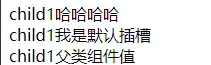
<child1></child1>
<child1>我是默認插槽</child1>
<child1>{{parentMsg}}</child1>
Vue.component('child1',{
    template:`<div>child1<slot>哈哈哈哈</slot></div>`
    })
結果:
註釋:
- 沒有設置子組件插槽內容,則會顯示子組件<slot></slot>中的內容
- 設置了子組件插槽內容,則插槽內容會替代<slot></slot>中的內容
- 子組件插槽內容是在父組件調用時設置,默認的作用域是父組件,因此可以訪問父組件的值,這點個人認為類似父組件給子組件傳值props,但是props主要傳遞值,插槽可以傳遞DOM
三:具名插槽
 <child2>
    <template slot="aaa">
        我是aaa具名插槽
    </template>
    <template slot="bbb">
        我是bbb具名插槽
    </template>
    <!-- V2.6.0之後的寫法縮寫 -->
    <template #ccc>
        我是ccc具名插槽
    </template>
</child2>
Vue.component('child2',{
    template:`<div>child2
        <slot name='aaa'></slot>
        <slot name='bbb'></slot>
        <slot name='ccc'></slot>
        </div>`
})
四:作用域插槽
<child3>
    <!-- V2.6.0之前的寫法 -->
    <template slot-scope="scope">
        {{scope}}
    </template>
</child3>
Vue.component('child3',{
    template:`<div>child3
         <slot :msg="msg"  text="哈哈哈"></slot>
        </div>`,
    data(){
       return{
           msg:"子組件的參數"
       }
    }
})
結果:

 <child4 >
    <!-- V2.6.0之後的寫法 -->
    <template v-slot="msg">
        <li>{{msg.msg.name}}{{msg.msg.age}}歲</li>
    </template>
</child4>
 Vue.component('child4',{
    template:`<div>child4
        <ul>
            <slot v-for="item in childMsg" :msg=item></slot>
        </ul>
        </div>`,
    data(){
       return{
           childMsg:[
               {
                   name:"張三",
                   age:18
               },
               {
                    name:"李四",
                   age:19
               }
           ]
       }
    }
})
結果: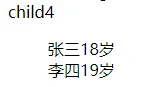
註釋:
作用域插槽與普通插槽區別:[作用域插槽]父組件插槽的內容能訪問子組件傳的數據[普通插槽]則不行
源碼地址: https://github.com/shangliaoy...
